Solid plans make stellar outcomes
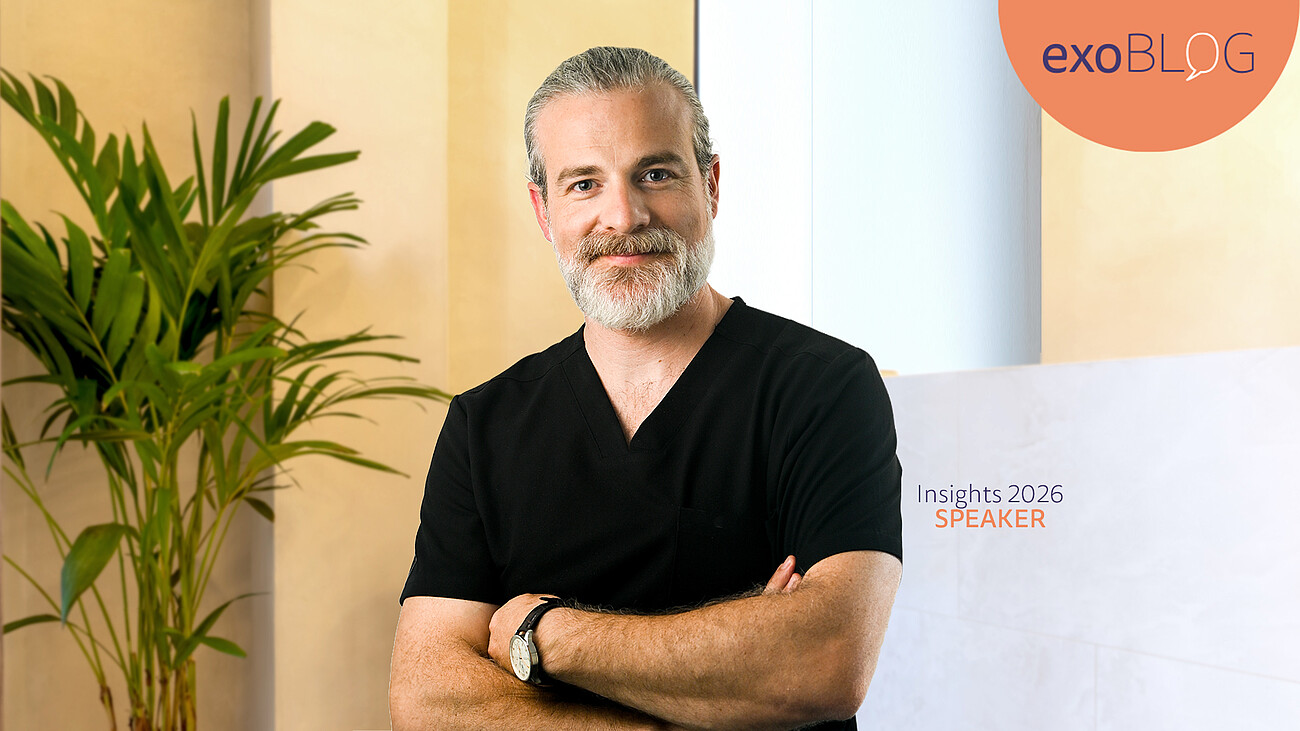
Dr. Alexis Ioannidis, a featured speaker at exocad Insights 2026, knows that great dentistry starts with a plan. Growing up in a family of dentists, he discovered digital workflows early and has been combining clinical work, teaching, and research ever since. In this exoBlog, Alexis shares how tools like TruSmile™ Video and TruSmile™ Photo are changing the game, why patient communication is key, and what attendees can expect from his exocad Insights 2026 lecture on turning plans into results.
Q: What first led you to dentistry?
A: That was easy. My mother, aunt, and uncle are all dentists, and my cousin, who is two years older than me, also started studying dentistry. I was exposed to the profession very early, so I didn’t spend much time questioning what I would do.
Q: Do you remember the first time you encountered exocad?
A: A dental technician sent me a webview link to review a case design. At that time, it felt completely new. I didn’t need to install anything—I could simply open the link, view the design and discuss it immediately. I remember seeing the purple interface for the first time. It was surprisingly simple and intuitive.
Q: Was there a moment when you realized digital dentistry isn’t the future—it’s the present?
A: Very early in my career. One of my first positions after completing my exams was at the former office of Prof. Dr. Werner Mörmann, one of the inventors of the first intraoral scanner. The technology itself was originally developed in the mid-1980s, long before I worked there, but the office maintained strong industry collaborations. As a young dentist, I had the opportunity to test pre-release scanners and software. Digital workflows were simply part of daily practice. It never felt like a “new” development to me. It was normal from the beginning.
“TruSmile Video and TruSmile Photo are real game changers. They allow us to simulate outcomes in ways that are impossible in analog dentistry.”
Alexis gives us a taste of what he will be talking about exocad Insights 2026 in Mallorca.
Q: How does the software fit into your daily work today, and what are your thoughts on recent releases such as DentalCAD 3.3 Chemnitz?
A: I mainly receive designs from dental laboratories, and the software dramatically improves communication. TruSmile Video and TruSmile Photo are real game changers. They allow us to simulate outcomes in ways that are impossible in analog dentistry. The simulations look extremely realistic, and planning becomes clearer. Patient communication also improves significantly. At the University of Zurich, where I continue to collaborate, we are conducting clinical studies on how patients and dentists perceive these video simulations. The preliminary findings are very interesting, and some results will be presented at exocad Insights.
“The key message for my Insights lecture is to focus on clear planning and meaningful patient involvement.”
Q: Speaking of exocad Insights 2026, can you share a takeaway from your lecture “Turning plans into results: Communication is the key”?
A: Of course! The key message for my Insights lecture is to focus on clear planning and meaningful patient involvement. You should always start with a plan. Dentists are trained to work with their hands, but the first step should be to think. Especially in complex cases, we must zoom out, see the big picture and create a clear plan before beginning treatment. And patients need to be involved in decision-making. In the past, dentists often decided independently. These days, patients should understand their options and actively participate. Tools such as TruSmile Video and TruSmile Photo make visualization and communication much easier.
Q: Why do you think minimally invasive prosthodontics is sometimes underestimated?
A: Prosthodontics has become increasingly biologically oriented. Biology is the foundation. We consider esthetics and function, but biology comes first. Preserving biological structures requires minimally invasive approaches. This demands precise planning and close collaboration between clinicians and laboratories, particularly in digital workflows. This can be more complex and requires skill on both sides.
Some clinicians may prefer standard preparations because they are manually easier. But minimally invasive dentistry requires individualized planning. Not every tooth needs the same approach. Sometimes, no preparation is necessary at all. Without proper planning, clinicians may begin drilling immediately instead of stepping back to see the bigger picture.
Q: What is one small digital step that makes a big difference in a practice?
A: Purchasing an intraoral scanner. In Switzerland, approximately 50% of practices already have one. It is not just a replacement for conventional impressions. You can overlap scans, compare clinical situations, visualize preparation areas and plan more precisely. For me, that is the most important first step.
Q: You’ve worked extensively in teaching, research and clinical practice. What keeps you excited about teaching?
A: Seeing others grow. I don’t believe in keeping knowledge to myself. The more we share, the more patients benefit. It is rewarding when someone improves on what you taught them and passes an even better version to the next generation. Teaching also keeps me sharp. I must stay current and continuously question my own thinking. I cannot teach material that is ten years old. I must remain present, or even slightly ahead.
Q: After all your experience, what still excites you about dentistry?
A: We are living in a very interesting period. Many digital tools exist, but connectivity between systems is often lacking. That is improving, and I hope companies continue to keep systems open and compatible. With AI emerging in recent years, entirely new possibilities are appearing. This constant evolution keeps dentistry exciting.
Q: Is there anything you’re especially looking forward to at exocad Insights?
A: It will be my first time in Mallorca, which is exciting. I’ve heard it’s a beautiful island. It will also be my first exocad Insights event, and I’ve heard the atmosphere is fantastic—great people in a great environment.
Q: If you weren’t in dentistry, what would you be doing?
A: At one point, I considered hotel school. Hospitality fascinates me. After opening my own practice in January, I’ve been able to incorporate hospitality concepts into the patient experience, like treating patients as guests. I’m also interested in graphic design, which I express through preparing lectures and designing presentations.
Q: What is the best advice you’ve ever received?
A: My mother told me when I was a child that no one is born a master. Mastery requires work. That advice stayed with me. She was right.
Q: One word for exocad?
A: Precision.
Dr. Alexis Ioannidis, PD Dr. med. dent., graduated from the University of Zurich in 2009 and completed postgraduate training in reconstructive dentistry at the same institution, followed by a research fellowship in Athens. In 2021, he received his Venia Legendi in minimally invasive prosthodontics and has served as head of fixed prosthodontics at the University of Zurich, a role he held until October 2025. From 2025 onwards, he has also run his private clinic in Zurich. Alexis is a certified specialist in reconstructive dentistry by the Swiss Society of Reconstructive Dentistry and holds master’s degrees in oral implantology and periodontology from the University of Zurich. His research and clinical work focus on minimally invasive restorations, implant dentistry and digital technologies in prosthodontics. He has published extensively in international journals, contributed to textbooks and remains affiliated with the Clinic of Reconstructive Dentistry at the University of Zurich. Follow Alexis’ work on Instagram.

by Caitlan Reeg
Writer at exocad
Caitlan Reeg spends her days telling the world about the innovations her colleagues create. She’s passionate about healthcare, technology, and the ways the two interact to improve our lives. A former journalist, Caitlan has worked on staff at Dow Jones Newswires in Frankfurt and at the national public radio program Marketplace in Los Angeles.