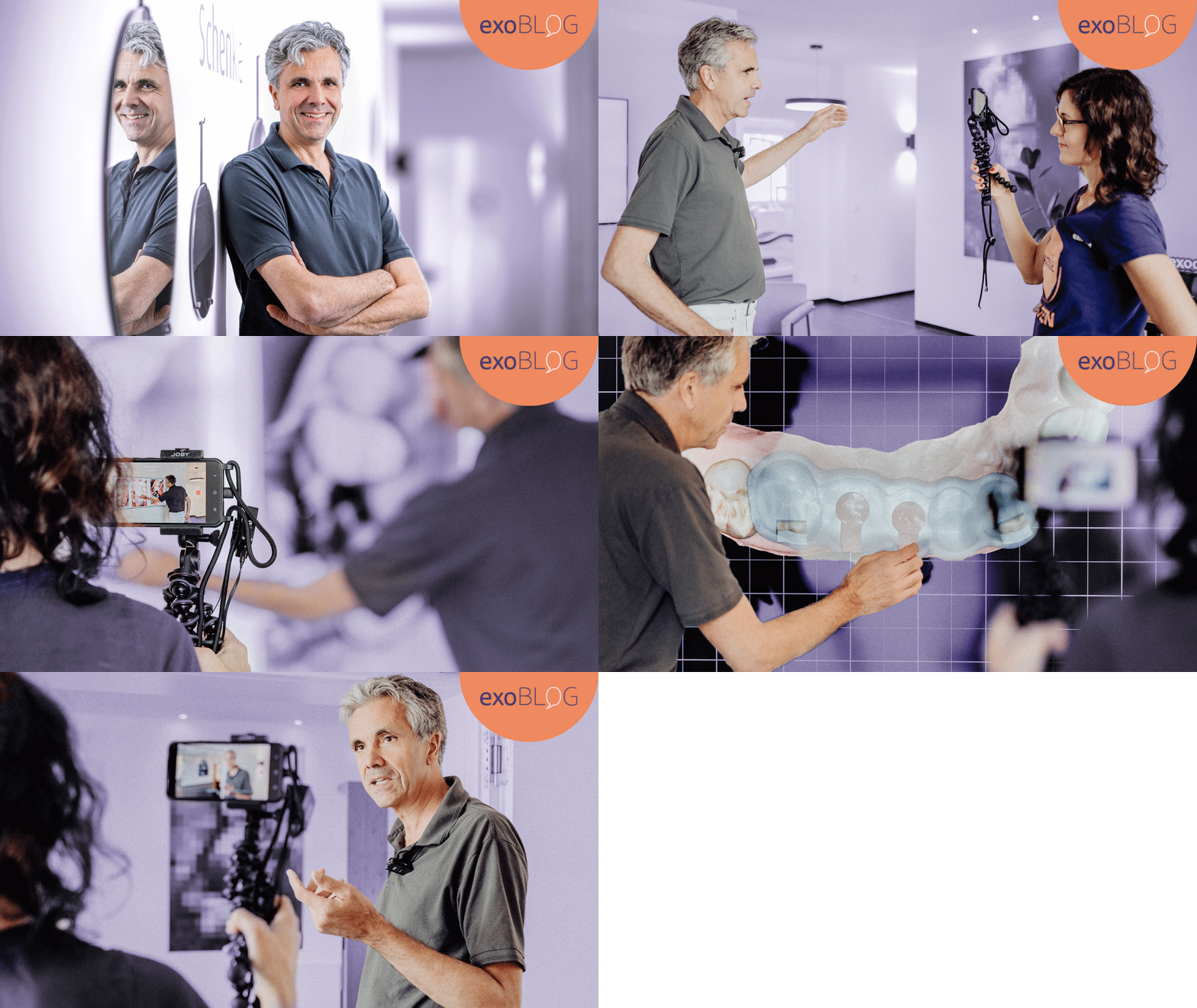
A third-generation dentist with a global academic journey—from Germany to Cape Town, Bern, and Harvard—Dr. Axel Zöllner brings decades of experience to his private practice. exocad visited Axel in Witten to see his workflow in action—from initial scans to final restorations—and to hear how exocad software helps streamline communication and support efficient, high-quality care.
Q: What was your introduction to digital dentistry and exocad software?
A: I specialize in prosthodontics, and here in Witten, we’re fortunate to have access to the Digital Competence Center with Frank Löhring and Dirk Langner, both pioneers in digital dentistry and experienced users of exocad software. Thanks to them, we were introduced to digital tools early on. As a practice, we quickly recognized the need for close collaboration with a lab. I still remember taking an impression downstairs, heading up to the lab, and thinking—wow, they’re already way ahead. That’s how I first encountered exocad. It wasn’t until much later, when we started using intraoral scanners, that I truly understood how critical it is to grasp the digital interfaces. That was the beginning—seeing exocad in action and gradually diving deeper into the digital workflow.
To watch this Youtube video, you must agree to the loading of functional and advertising cookies. You can find a link to change your cookie preferences at the bottom of this page.
Axel explains how streamlined dentist-lab communication can make the implant process smoother, smarter, and more efficient.
Q: Which exocad software do you use?
A: Honestly, we use almost everything. Since we also work in research and teaching, we have access to the full range. The Smile Creator Module is something we find incredibly exciting—we love the potential, especially as a visualization tool both for ourselves and patients.
“For dentists, digital workflows can be like learning a new language, but once you understand the vocabulary, it opens up so many possibilities.”
Q: Are there features in the software that you think many dentists don't know about? Any favorites?
A: I think sometimes dentists need to get familiar with the vocabulary used. For example, if I ask dentists at a congress whether they know the term 'save a scene,' nine out of ten won't know what that is. Or the concept of adding a mesh—many don’t know that either. Most lab techs get it already. For dentists, digital workflows can be like learning a new language, but once you understand the vocabulary, it opens up so many possibilities.
Q: Do you have a favorite feature or tool?
A: I have many. For example, when we do large cases, we always design anatomically first, print a trial version, and try it in. Then we do intraoral scanning again to capture precise data. When I model contact points esthetically, I can send that exact digital file to the lab via my iTero scanner, and the lab can match it exactly. But if you’re asking for a favorite tool that I use it’s dentalshare. That’s a real game-changer for us. That helps a lot with communication.
Q: For dentists new to digital workflows, where do you recommend they start?
A: We’re part of a curriculum from the DGI (German Association for Implantology), and for the fourth module, we host it in our practice. We limit it to 10 people—ideally five dentists and their technicians. The questions are often very basic, not high-tech. Things like: ‘How do you manage your data? How do you export and import? What file formats do you use?’
We let technicians scan like dentists and vice versa. The idea is to get hands-on experience. There’s a moment where you’re asked, ‘Do you want to trim intersections?’ and as a dentist, you think—of course not, I’m precise! But you don’t understand what that means. It's the same with ‘equilibrating’ models—it's just correcting mismatches in bite registration. So learning this vocabulary and thought process is key.
“Sometimes, I walk patients through the practice, showing them how their data moves. That builds trust—their treatment process becomes so transparent.”
Q: How has this digital workflow changed the patient experience?
A: The biggest leap was when we started scanning digitally. Patients notice that immediately. Sometimes, I walk patients through the practice, showing them how their data moves. That builds trust—their treatment process becomes so transparent.
One case really stands out — a woman had multiple composite restorations in the anterior teeth and we were both hesitant about veneers. But through digital simulation and prep guides, we were able to show her exactly what minimal preparation would be needed. She saw it, understood it, and said, ‘Let’s do it.’ That’s the power of planning and visualization.
Q: How did you introduce digital workflows to your team?
A: That part is easy. I'm not a digital native—but if I enjoy it, and my assistants, who are half my age, see me doing it, they get excited and want to jump in too. We’ve supported some master’s theses on learning curves and found that after 5–10 sessions, people reach a solid level—whether they had prior experience or not. You just need to support them early on.
Q: Do you have a favorite tooth to work on?
A: The upper molar. It’s fascinating anatomically and functionally.
Q: What do you do to relax outside of dentistry?
A: I row. I started in Essen and still do it here. I also run. Just a couple weeks ago, I did the Karwendelmarsch with my youngest daughter—35 kilometers and 1,400 meters elevation. My middle daughter did the 52k version. I did that one two years ago.
Q: Lastly, one word for exocad?
A: Innovative.
Dr. Axel Zöllner received his dental education at Witten/Herdecke University in Germany, followed by advanced training in dental surgery at the University of Cape Town (South Africa), periodontology and prosthodontics at the University of Bern (Switzerland), and implantology at Harvard University (USA). Axel is the founder and director of the International Institute for Dental Education and Research, where he shares his expertise, particularly in implant prosthetics, on both national and international stages. As a lecturer on leading-edge dental technologies, he ensures that the latest advancements are also integrated into his everyday clinical practice. Follow the practice on Facebook or Instagram.
by Caitlan Reeg Writer at exocad
Caitlan Reeg spends her days telling the world about the innovations her colleagues create. She’s passionate about healthcare, technology, and the ways the two interact to improve our lives. A former journalist, Caitlan has worked on staff at Dow Jones Newswires in Frankfurt and at the national public radio program Marketplace in Los Angeles.