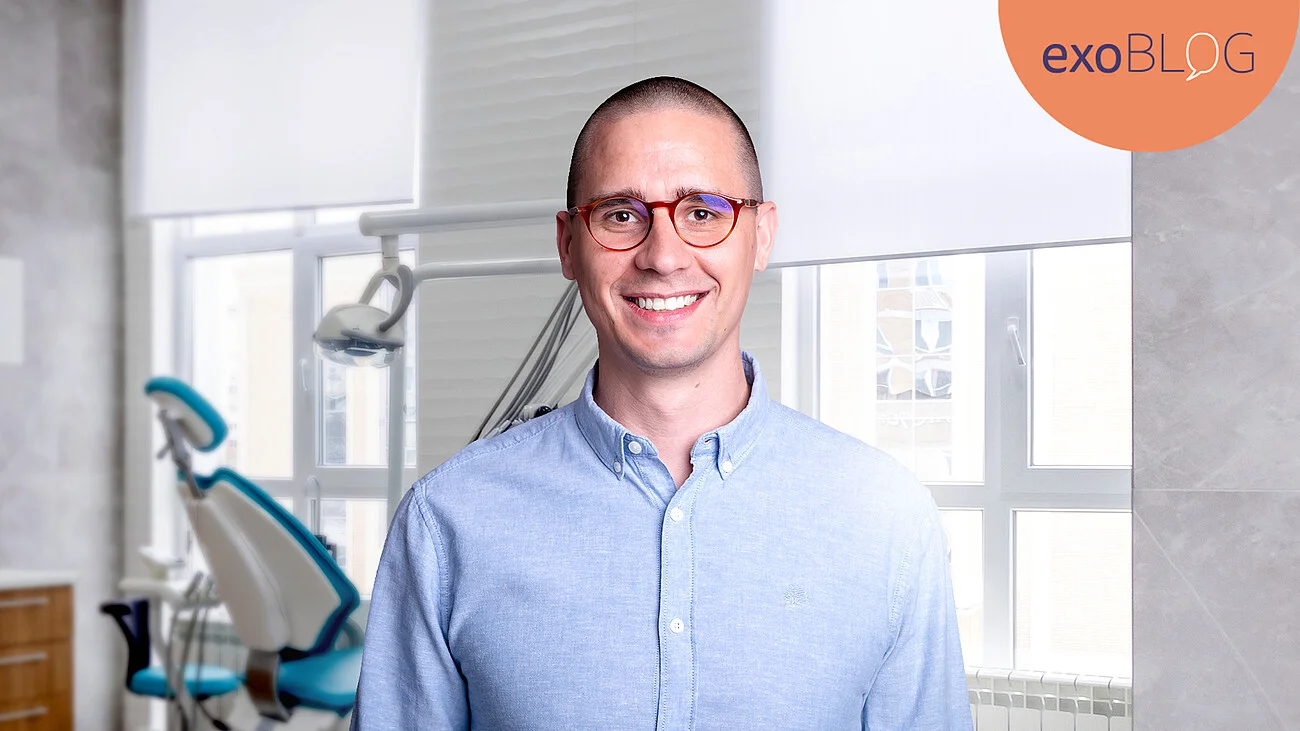
Curious students build amazing careers
For many dental students, digital dentistry is still limited to a few classroom exercises. For Dr. János Panyi, it became something to explore long before graduation. After discovering exocad software through the student license, he spent countless hours experimenting with digital workflows, building the skills he now uses every day in practice. We spoke with János about his path from dental student to clinician, the importance of curiosity, and why today's students should start learning digital dentistry as early as possible.
Q: Tell us a little about yourself. What inspired you to become a dentist?
A: Healthcare was always part of my life. My grandfather taught chemistry and biology, so even when we went fishing together, we talked about science. My father is a Master Dental Technician. Growing up around his laboratory, he introduced me to dentistry from an early age.
Originally, I wanted to study general medicine because I was interested in guided surgery. But after meeting dentists during an intraoral scanner comparison study that my father's laboratory participated in, I realized dentistry was the right path for me. When my father bought his first CAD/CAM system, I fell in love with digital dentistry.
“When exocad introduced the student license, I saw it as the perfect opportunity to keep learning on my own. I bought the student license, downloaded exoplan and started recreating everything we were learning in implantology.”
Q: When did you first discover exocad?
A: Once I became interested in digital dentistry, I started following everything happening in the industry. I wanted to know which software companies were leading innovation and what new technologies were available. It's almost impossible to be interested in digital dentistry without hearing about exocad. I saw it as the market leader, so naturally, I wanted to learn about exocad software.
Q: How did the exocad student license help you?
A: At my university, we only had one semester dedicated to digital dentistry. We learned the basics of milling, intraoral scanning, and designed a few restorations, but there wasn't much opportunity to continue practicing. When exocad introduced the student license, I saw it as the perfect opportunity to keep learning on my own. I bought the student license, downloaded exoplan and started recreating everything we were learning in implantology. Being able to merge CBCT data with digital impressions was a huge "wow" moment for me.
Then I started experimenting to learn more. Whenever I had free time, I pushed the limits of exoplan to see what it could do.
“Working with exoplan helped me better understand those concepts I was studying, and it played an important role in helping me successfully defend my thesis.”
Q: How did that experience help you as a student?
A: My thesis focused on guided endodontics, comparing static and dynamic navigation. Although guided endodontics is different from implant planning, the principles behind guided treatment are very similar. Working with exoplan helped me better understand those concepts I was studying, and it played an important role in helping me successfully defend my thesis.
Q: Was there enough digital dentistry education during dental school?
A: We learned the fundamentals, but I believe digital dentistry should be considered part of those fundamentals today. My university gave us a good introduction, but there were limited opportunities to continue developing those skills. That's why I spent so much time learning outside the classroom. Whenever I had the chance to use an intraoral scanner with a patient, I took it. Digital dentistry isn't just the future anymore. It's already here.
Q: What trends do you see among young dentists entering the profession?
A: When I was in school, digital dentistry wasn't very popular among students because we had limited access to the technology. That has changed quickly. Today, many clinics in Hungary are adopting intraoral scanners, and more young dentists recognize that digital workflows are becoming essential. One of my colleagues always says, "Whoever falls behind gets left behind." I think that's true. It's important to become familiar with digital dentistry early.
Q: Tell us about your career today.
A: I'm currently working as a general dentist at Precedent Dentistry, where I focus on restorative dentistry, prosthetics, and minor oral surgery. I use intraoral scanners for my prosthetic cases and work together with my mentor, Dr. Levente Sidó, to plan implant surgeries and create surgical guides. I also help manage my family's dental laboratory Prodont Dental Lab, supporting technicians with implant planning and exocad workflows. In the future, I'd like to complete an oral surgery residency and eventually plan and place implants using guides that I design myself.
Q: Many people say younger dentists have an intuitive understanding of digital workflows. Do you agree?
A: I do. My generation grew up using computers, so understanding digital workflows feels natural. At the same time, it's still important to understand traditional analog workflows. When you understand both, you can combine that knowledge to create even better digital solutions.
“Be curious. If you have access to an intraoral scanner, scan everything. That's how you'll learn the capabilities and the limitations of the hardware and software.”
Q: What advice would you give today's dental students?
A: Be curious. If you have access to an intraoral scanner, scan everything. That's how you'll learn the capabilities and the limitations of the hardware and software. The same goes for design software. Design everything. Design a Christmas tree if you want. Just keep experimenting and push the limits. That's how you learn.
Q: What song is at the top of your playlist?
A: It's always "Daybreak" by Overwerk. That song motivates me.
Q: What are your interests outside of dentistry?
A: I used to be a competitive cyclist but then decided it took too hard a toll on the body. These days, I enjoy running. About six months ago, I completed my first marathon. Whenever we have the opportunity, my wife and I also like to explore Hungary’s lakes and rivers on our SUP.
Q: Best advice you ever got?
A: It was from my father. He told me that whatever I do in life, I should do it well and with the same dedication that I had in cycling. Give everything I can, and success will follow.
Q: Finally, if you could describe exocad in one word, what would it be?
A: Future.
Dr. János Panyi graduated from the Faculty of Dentistry at the University of Debrecen in Hungary. Growing up in his family's dental laboratory, he gained over a decade of hands-on experience in CAD/CAM technologies and digital workflows before even earning his dental degree. Currently, he works as a dentist at Precedent and Aquadent Dentistry, focusing on prosthetics, restorative dentistry, and guided implantology. Concurrently, he co-manages the Prodont Dental Laboratory alongside his father, a master dental technician with 40 years of experience. János represents a unique dual perspective in dentistry, seamlessly merging decades of traditional analog craftsmanship with cutting-edge digital precision. Passionate about pushing the boundaries of exocad and digital impression systems, he is dedicated to delivering the highest quality restorations by understanding the workflow from both the clinical and technical sides. You can follow János on LinkedIn.

by Caitlan Reeg
Writer at exocad
Caitlan Reeg spends her days telling the world about the innovations her colleagues create. She’s passionate about healthcare, technology, and the ways the two interact to improve our lives. A former journalist, Caitlan has worked on staff at Dow Jones Newswires in Frankfurt and at the national public radio program Marketplace in Los Angeles.